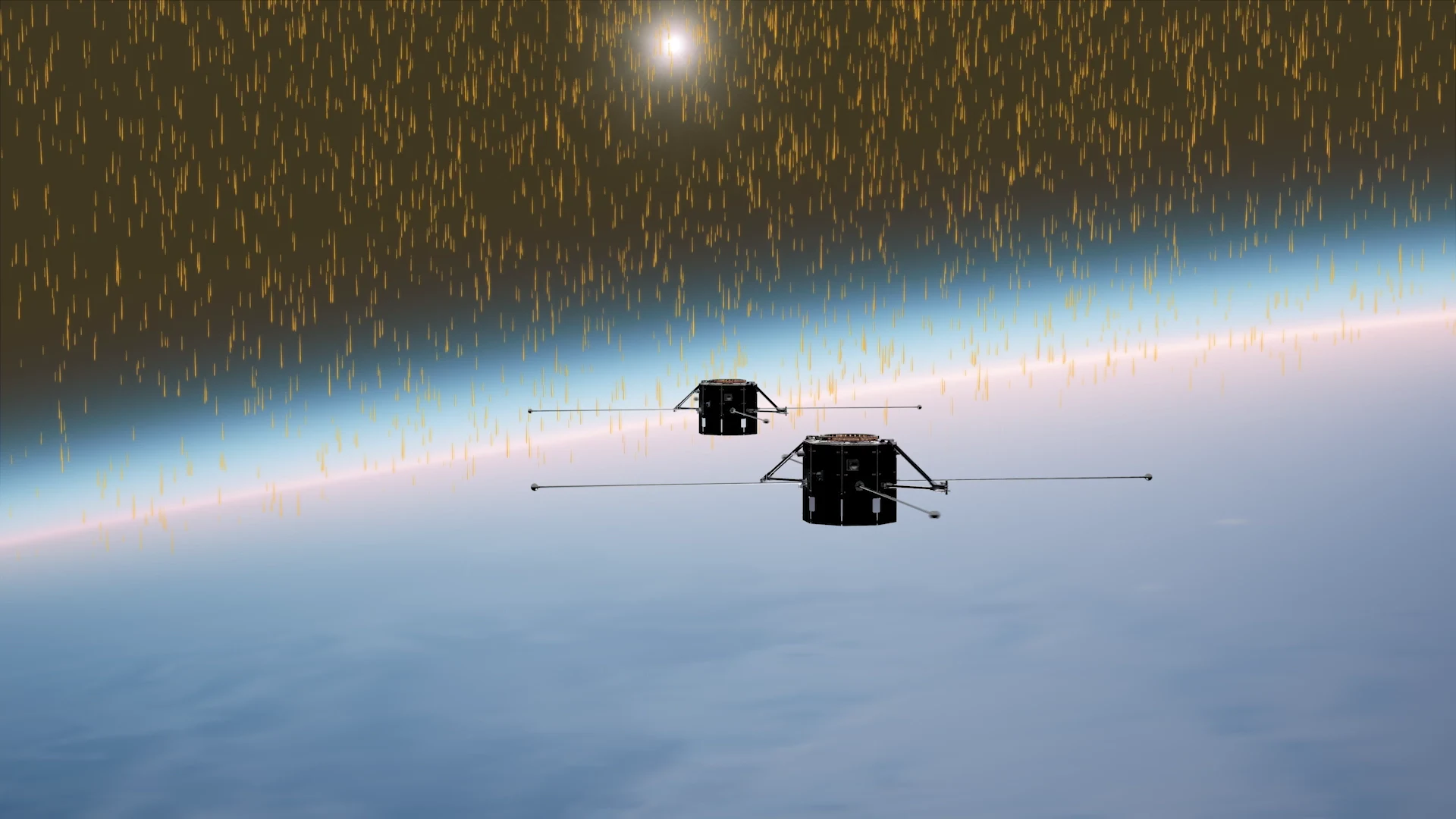
Two spacecraft instead of one snapshot
TRACERS flies as a pair in a Sun-synchronous orbit, with one spacecraft following the other through the southern polar cusp where solar-wind particles are funnelled toward Earth. The small delay between measurements distinguishes two possibilities: the process may be evolving rapidly in time, or the region being sampled may be moving through space. Data from November 2025 to February 2026 indicate that spatial variability dominated by at least a factor of two across different interplanetary magnetic-field orientations and solar-wind pressures.
A preliminary result with practical follow-up
The authors stress that almost every event classified as spatial also contained some temporal variability, so more paired passes are needed. After a post-launch communications setback, the team restored routine data collection, and NASA extended the prime mission into spring 2027. Magnetic reconnection links the solar wind to Earth's magnetosphere; understanding its behaviour matters for models of geomagnetic storms that can affect satellites, communications, power grids and crews. This first paper is not a finished space-weather forecast, but it narrows the physical mechanism that future forecasting systems must represent.
Sources
- NASA Science — TRACERS first results offer a peek into magnetic reconnection · 29 October 2026
- Journal of Geophysical Research — First Results From TRACERS · 29 October 2026