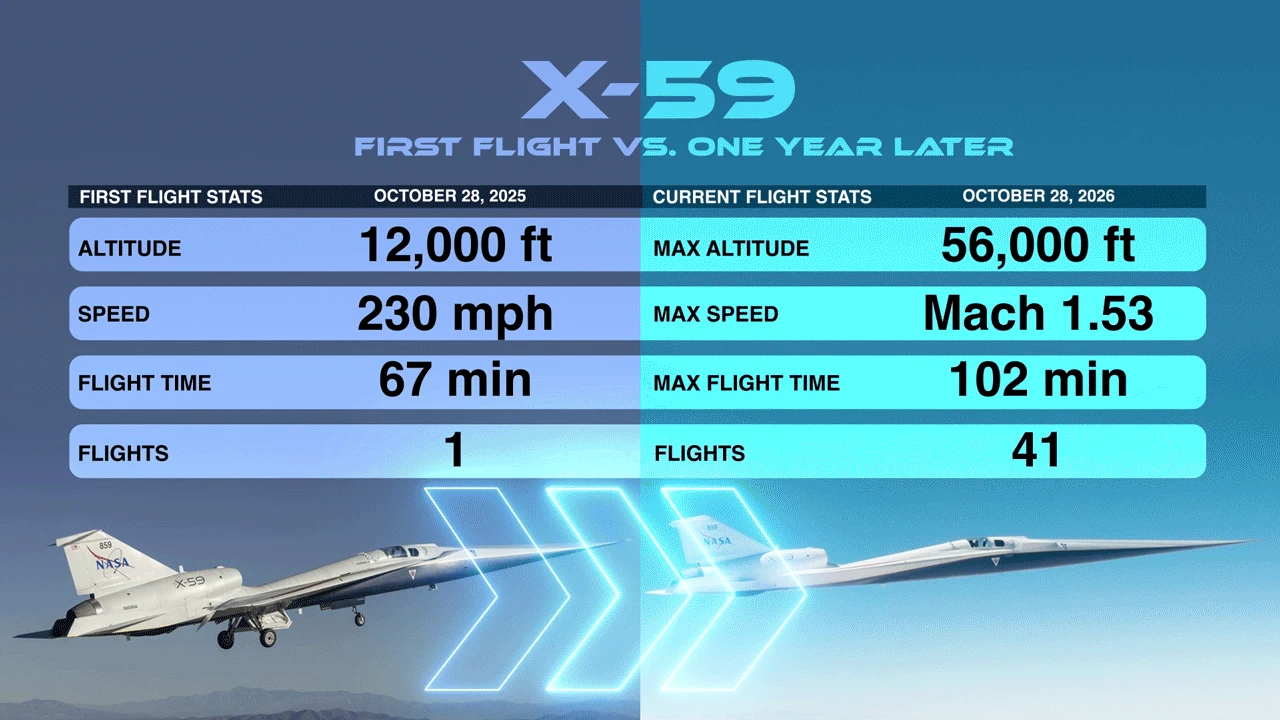
From a cautious first sortie to supersonic conditions
The X-59's first flight on 28 October 2025 stayed low and slow while the team checked its systems. Over the following twelve months, the experimental aircraft flew 40 more times, climbed above 56,000 feet and reached Mach 1.53. That exceeds the mission condition of roughly Mach 1.4 at 55,000 feet. The speed record should not be confused with the project's purpose. The X-59 was designed not to be the fastest aircraft but to shape shock waves so they do not combine into a conventional, disruptive sonic boom.
The promised quiet thump is the next test
With the flight envelope expanded, the team is moving toward acoustic validation. NASA projects that people on the ground will hear a muted thump comparable to a car door closing from about 20 feet away. Future flights will record and measure that sound, followed later by community-response work. Regulators can use those data when deciding whether restrictions on civil supersonic flight over land should change. Until then, the X-59 remains a research prototype: 41 successful flights demonstrate growing maturity of the aircraft, but they do not yet prove that its sound will be acceptable to communities.
Sources
- NASA Quesst — NASA Celebrates a Year of Progress Since First X-59 Flight · 28 October 2026