The path of a city request
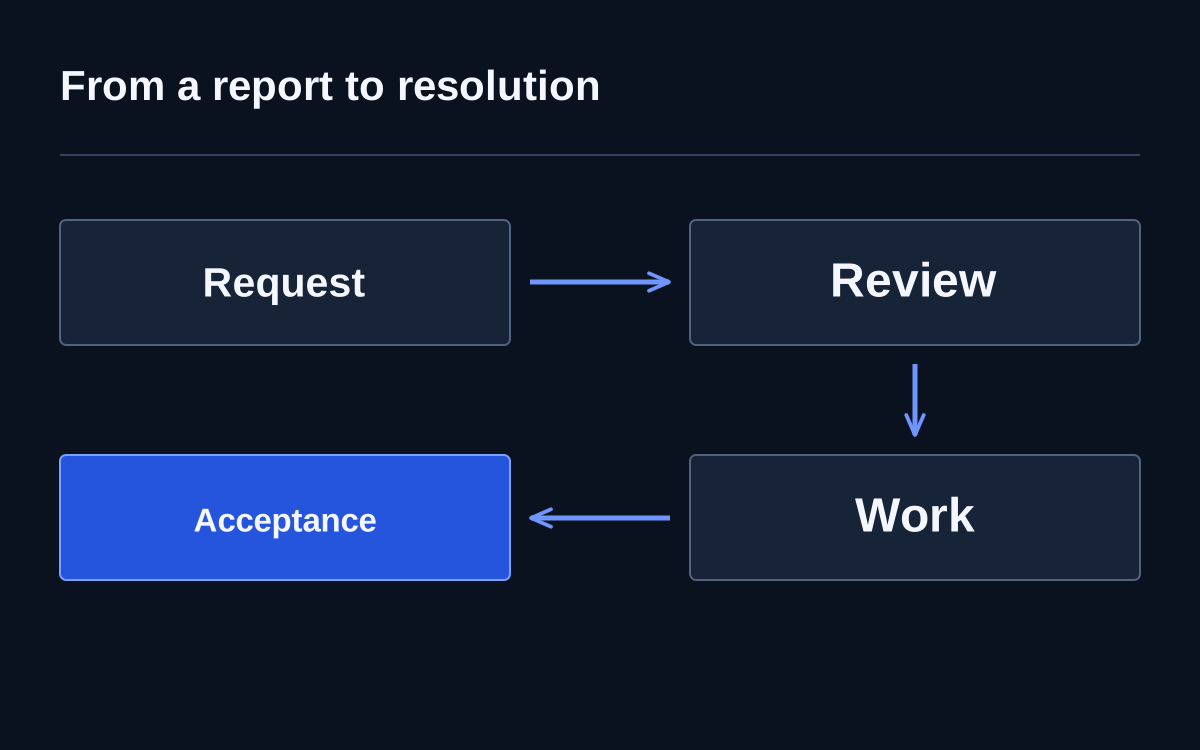
A sensor reports a fault; a city service checks the alert, assigns the work and confirms the repair. Delays occur at the handovers. Following one request from the reported problem to a working streetlight, dry passage or open road helps expose them.
Imagine flooding at an interchange
Imagine a fictional district where a sensor detects standing water at a bus stop after heavy rain. Road services manage drainage, the operator manages boarding and an information service warns passengers. Every system works, but only road services receive the message. People keep walking to an inaccessible stop.
The shared process must connect detection with verification, temporary boarding arrangements and passenger information. Once the cause is fixed, the warning must also be withdrawn. This final transition is often forgotten: the physical problem is solved while digital directions still send people on a detour.
The object must be recognisable
Different registers may name one stop after its street, shopping centre or route number. Exchanging events requires agreement on the physical object, its location and the services involved. An attractive combination of maps does not resolve differences in definitions.
Start with a mapping table for a limited area. Identify the source of the primary identifier and the correction procedure. If a stop is temporarily moved, distinguish the transport-network object from its current boarding location. Otherwise an availability message can have the correct name but the wrong coordinates.
Responsibility crosses departmental boundaries
A shared process must establish who accepts an event, resolves disputed cases and monitors waiting time. Sending a message does not mean a task has been accepted. If the recipient has not confirmed readiness, the sender should not consider its part finished without a further route.
Describe missing responses and unavailable systems too. The bus-stop example needs an alternative communication method and somebody authorised to agree a temporary action. These organisational conditions do not arise from integration alone. Technology makes handovers observable but does not assign authority itself.
A shared measure puts local improvements in context
One service may accept a request quickly and another dispatch staff quickly while the overall process remains slow because of waiting between them. Measure time from a verified problem to restored function. Retain individual stages for diagnosis instead of combining positive departmental reports into an assumption of overall success.
For passengers, check information quality too: when the warning appeared, whether it matched the location and when it disappeared. Drainage and information are separate outcomes in this example. Improvement in one does not prove improvement in the other, so observe both.
A pilot tests coordination
Choose one situation and area involving several services. Walk through an agreed practice event: detection, confirmation, assignment, execution, informing residents and closure. Record handovers that required phoning a personal contact or manually finding an object.