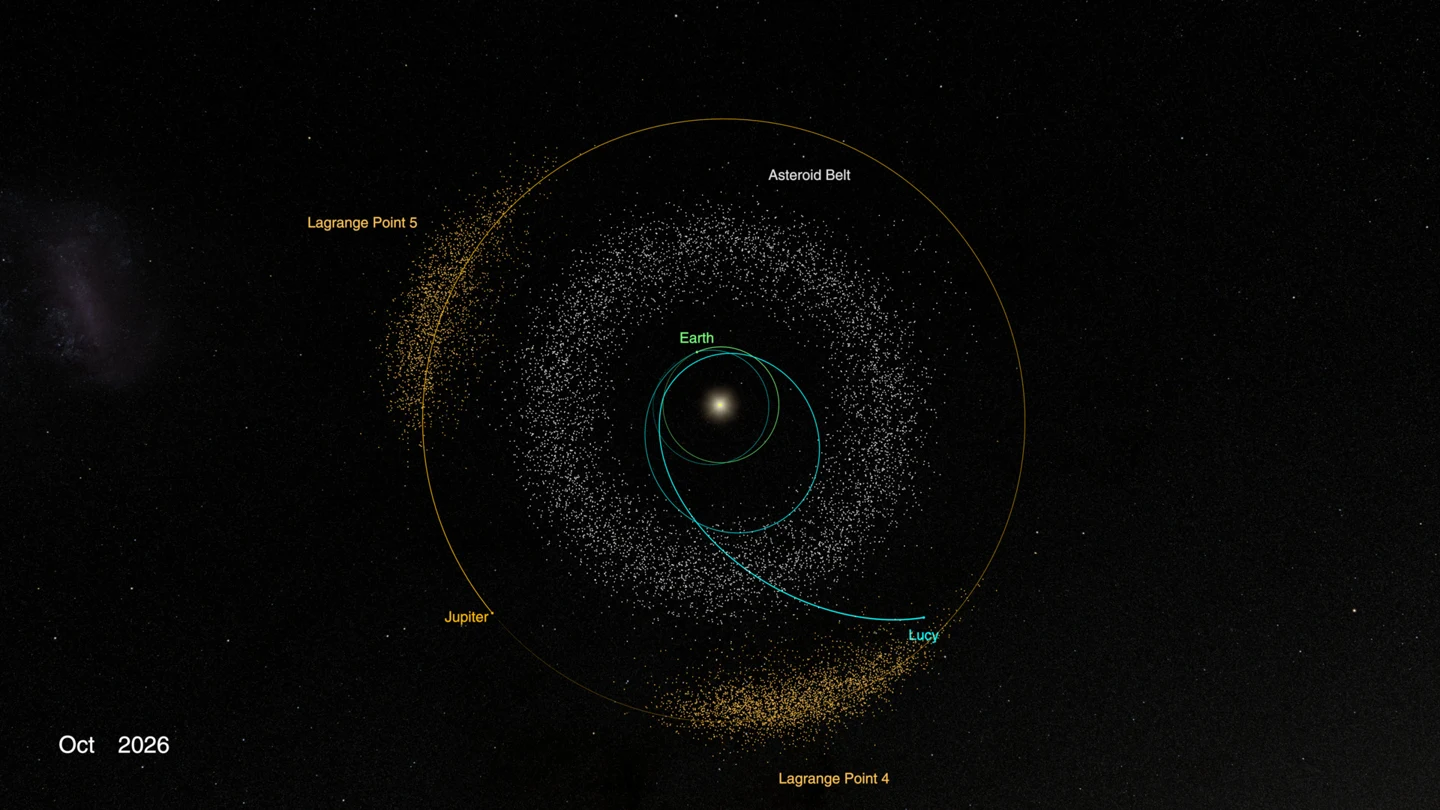
A boundary without a marker
The L4 region has no physical edge, so the team determines entry from radio tracking and images of surrounding stars. Thousands of Trojan asteroids share Jupiter's orbit ahead of the planet, held there by the combined gravity of the Sun and the gas giant. Lucy launched on 16 October 2021 and had travelled more than 2.2 billion miles when NASA reported the milestone. Other spacecraft have visited Jupiter, but none had a reason to travel into these distant concentrations of small bodies.
Arrival begins a long sequence of encounters
Eurybates will be the first target on 11 August 2027. Lucy is then due to visit Polymele, Leucus and Orus, return to Earth for a gravity assist in 2030, and reach the Patroclus-Menoetius binary in the trailing L5 cloud in 2033. The instruments are operating normally at more than five times Earth's distance from the Sun while the team prepares for the few hours available at each close pass. The value is not merely a new set of pictures: the Trojans' composition, mass and geology can test models of how planetary orbits were rearranged 4.5 billion years ago.