State the hypothesis
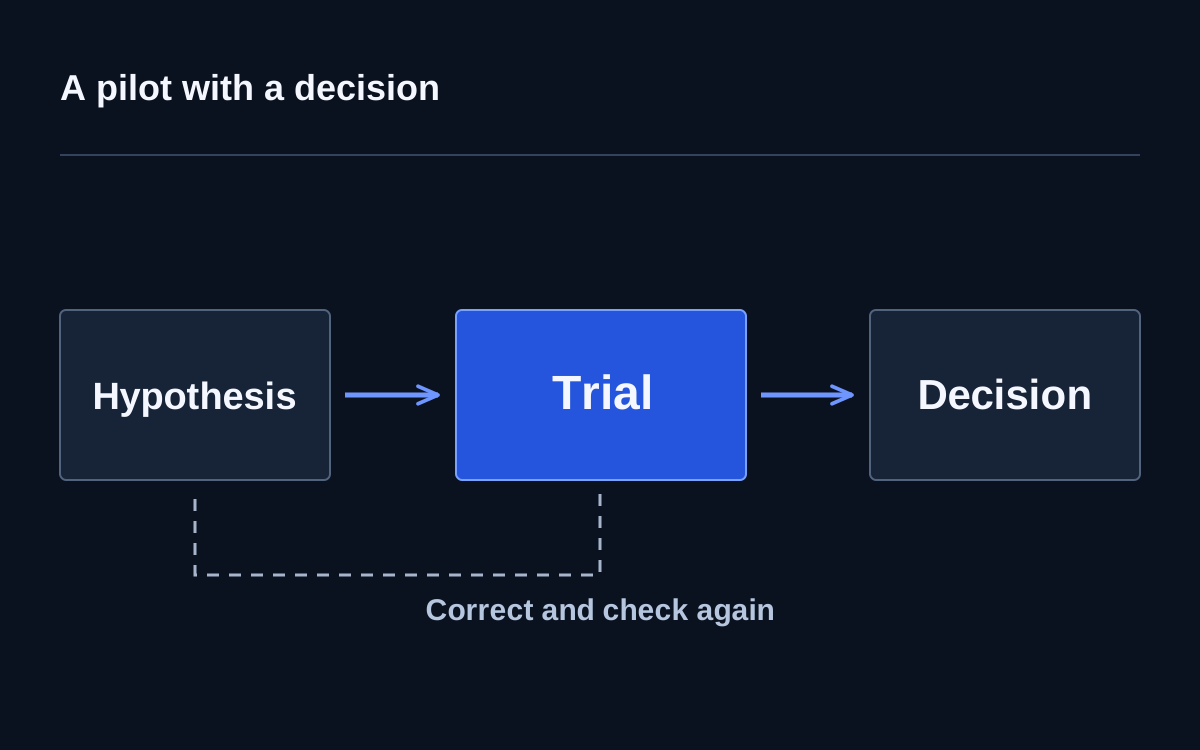
A pilot tests a specific proposition, such as whether AI reduces drafting time while maintaining review quality. Answering it requires one process, baseline measures and an agreed success criterion. A general aim to “try AI” does not establish those conditions.
Turning an idea into a testable hypothesis
Consider a pilot for answering questions from an internal knowledge base. Saying employees will find it easier permits almost any outcome. A useful hypothesis connects a result with a constraint: employees find a verified rule faster without increasing answers based on incorrect sources. Define a finished answer and an error before launch, or each side will assess its own version of success.
Record the original process on comparable tasks. Testing the new tool on easy questions while measuring the old method during difficult enquiries weakens comparison. Small pilots especially need sample composition and exceptions described. This prevents random flow changes being mistaken for technology's effect; it is not laboratory precision merely for a report.
Boundaries protect the result
Create a short experiment card: task, participants, sources, allowed actions, observation period, owner and decision rules. Include what is not being tested. Search over one collection does not prove readiness for every corporate document. Boundaries keep conclusions honest and prevent each attractive extra capability from expanding the pilot.
Changes will still occur. Record their reason and introduction time: revised instructions, replaced sources or added access checks. If results improve sharply, the team can identify what helped; if they worsen, it can reverse course. Several silent simultaneous changes make final reporting nearly useless for further implementation.
Three reasonable endings
A pilot can end in expansion, limited use or stopping. Each needs clear grounds in advance. Expansion requires both good answers and operational readiness: data maintenance, failure response and new-user training. Limited use fits benefits confined to one task type. Stopping makes sense when correction costs outweigh gains.