Define what must survive
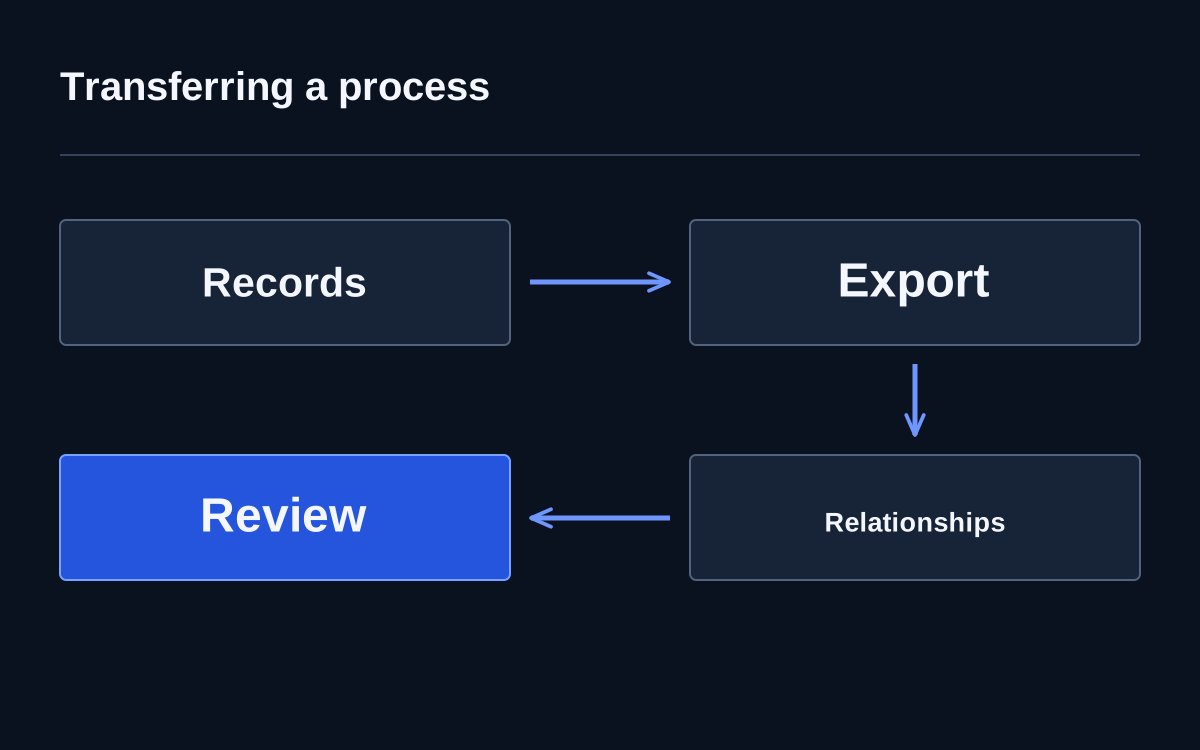
Moving to another service requires more than the main records. A process may depend on attachments, relationships, reference data and change history. The export is checked against that inventory, followed by an attempt to restore the workflow in the new system.
Behind the export button
Suppose a CRM exports a customer list to a spreadsheet. Continuing work also needs deals, organisation-contact relationships, attachments, history and reference values. An export preserving only visible fields produces a name archive, not a transferable process. Start by listing the objects and relationships users need for an ordinary task in another tool.
Check identifiers and formats separately. Same-named contacts must not merge, attachment links must not disappear when access closes and dates must remain unambiguous. Take several connected records and reconstruct a deal's history outside the original interface. If impossible, establish what is missing and which supported method can retrieve it.
A rehearsal rather than theoretical possibility
Prepare a small authorised sample: an ordinary record, one with several relationships and a complex case with changes. Export normally and inspect it in an independent viewer or test system. Compare object counts, required fields and attachment contents. A successful download says nothing about continuing after a real move.
Then describe migration order: who makes the first export, how new changes are captured, when editing is restricted and who confirms success. Even a good format does not prevent records being lost between exports. A critical process needs a reconciliation period and a way back if checks reveal discrepancies. Establish this before an urgent need to leave arises.
Use the findings when selecting a service
An exit plan creates specific supplier questions: available entities, volume limits, attachment retrieval and preserved history. Check answers against current product documentation and organisational agreements. A general promise that data is always yours is insufficient for an engineering plan. Understand how and how quickly it can become a working system.