Two ways to organise work
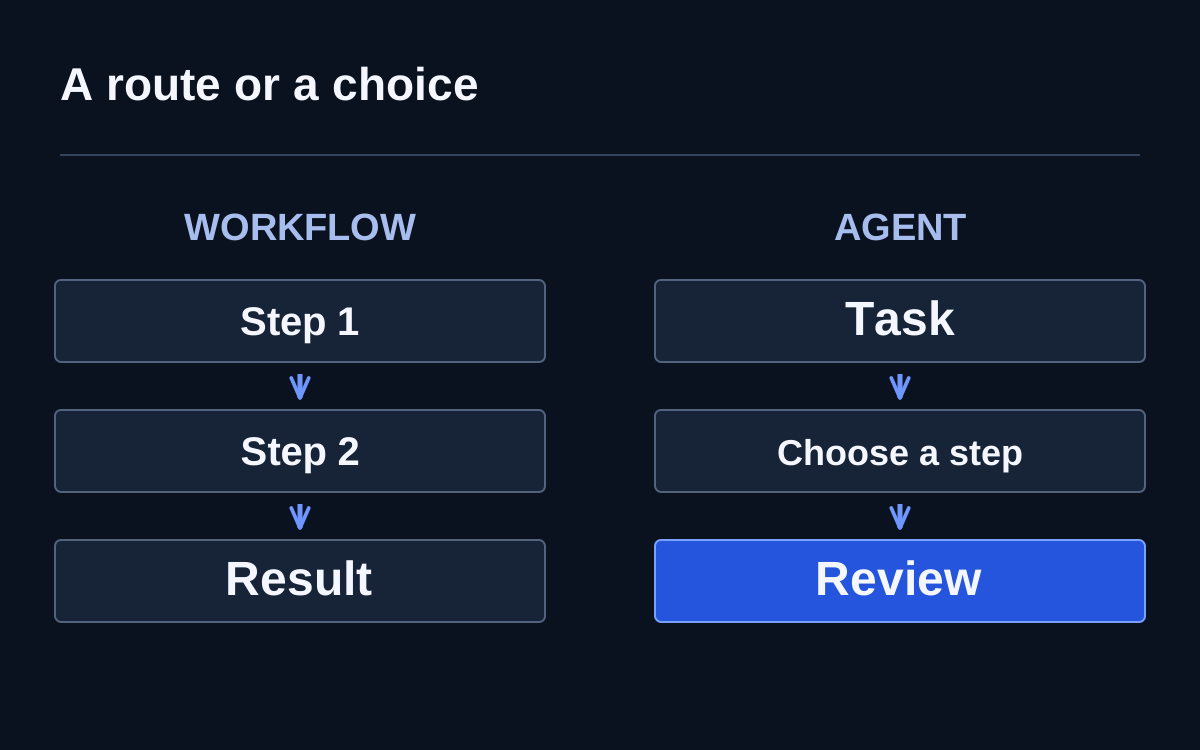
A workflow follows a predefined sequence: receive a request, identify its subject, prepare a draft and pass it to an employee. An agent chooses the next tool and adjusts its plan based on intermediate results. Anthropic uses this distinction in its account of agent-system architecture.
Example: a repair request
Imagine a service company receiving a device number and fault description. The next steps are always warranty verification, service-centre selection and an appointment offer. If those steps are stable, a workflow can call a model only to interpret free text. The model need not invent the whole route. A clear sequence makes it easier to see where information ran out and why a booking was not completed.
A different task is investigating an unexpected equipment fault using logs, a manual and several checks. Here, the next step depends on earlier findings. An agent may be appropriate, choosing an available tool and refining a hypothesis. Its freedom still needs limits: tools, accessible objects, maximum duration and conditions for handing over to a specialist.
The cost of choosing
Compare more than final writing quality. An agent can make extra requests, repeat failed actions and contact several systems, affecting cost, delay and investigation complexity. Fixed workflows can also be brittle: a new exception requires a route change. The choice depends on the uncertainty actually present and what the organisation will pay to handle it.
Pay particular attention to retries. If an external service does not respond, that does not establish that its operation failed. Repeating a booking could create two appointments. Operation identifiers, state checks and a clear continuation method are needed. This problem exists without AI, but freely chosen steps make it less visible in a successful demonstration.
Compare the same work
Take one task set and build the simplest working workflow. Compare an agent version: completed requests, human interventions, unnecessary actions and waiting time. Examine difficult cases separately from averages. A few expensive retries may hide among easy tasks until volume grows.