Choose the decision point
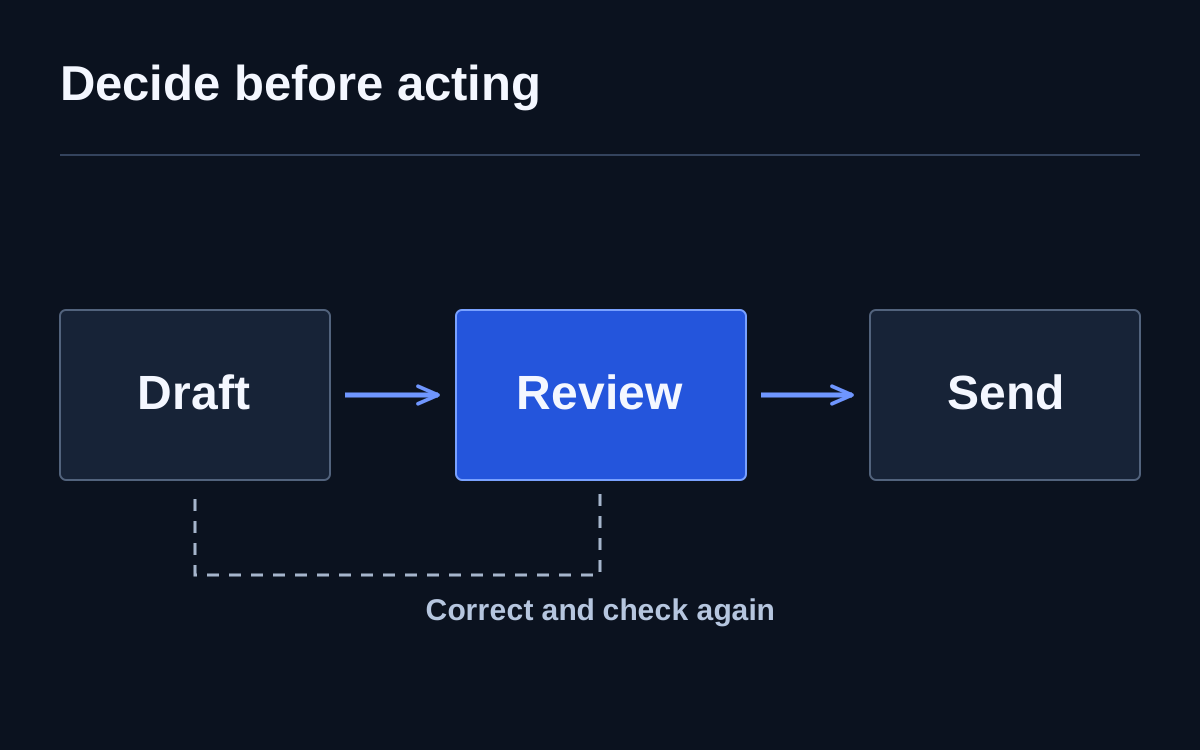
A draft is easy to correct before sending. A distributed message or a change in a production system is harder to reverse. Human review therefore belongs before actions whose consequences require oversight, with the information the reviewer needs to decide.
Review at the right moment
Suppose an assistant drafts and sends a customer response before notifying an employee. A person is formally in the process but cannot change the outcome before the external action. A useful checkpoint comes before a hard-to-reverse step: publication, access changes or sending an agreement. Preparatory operations need not require confirmation of every movement.
Begin with a decision map. Which actions only read data, which create an internal draft and which change an external system? For each group, define who may decide and what information they need. This avoids endless approvals of trivial steps as well as important permissions silently delegated under a general continue button.
What to show a reviewer
A message saying everything is ready is insufficient. For a hypothetical return, an employee needs the order, reason, applicable rule, proposed operation and any contradictions. An excessively long account also obscures important details. A useful review screen explains what will happen, on what basis and what will change after approval. Sources and inputs should open alongside it.
Rejection and correction must be proper actions. If an employee notices a wrong amount, they need to return the task with a specific reason; the system must retain the correction and avoid repeating the operation. Observe review time and frequently changed fields. This reveals whether automation helps and where it lacks context.
Keeping oversight meaningful
People presented with many identical confirmations daily may stop distinguishing cases. Separate routine and unusual situations using agreed rules. An internal draft may be prepared automatically while a decision involving contradictory data goes to a specialist. Criteria must be clear and testable; confident model wording alone cannot justify removing review.