Successful copying answers a narrow question
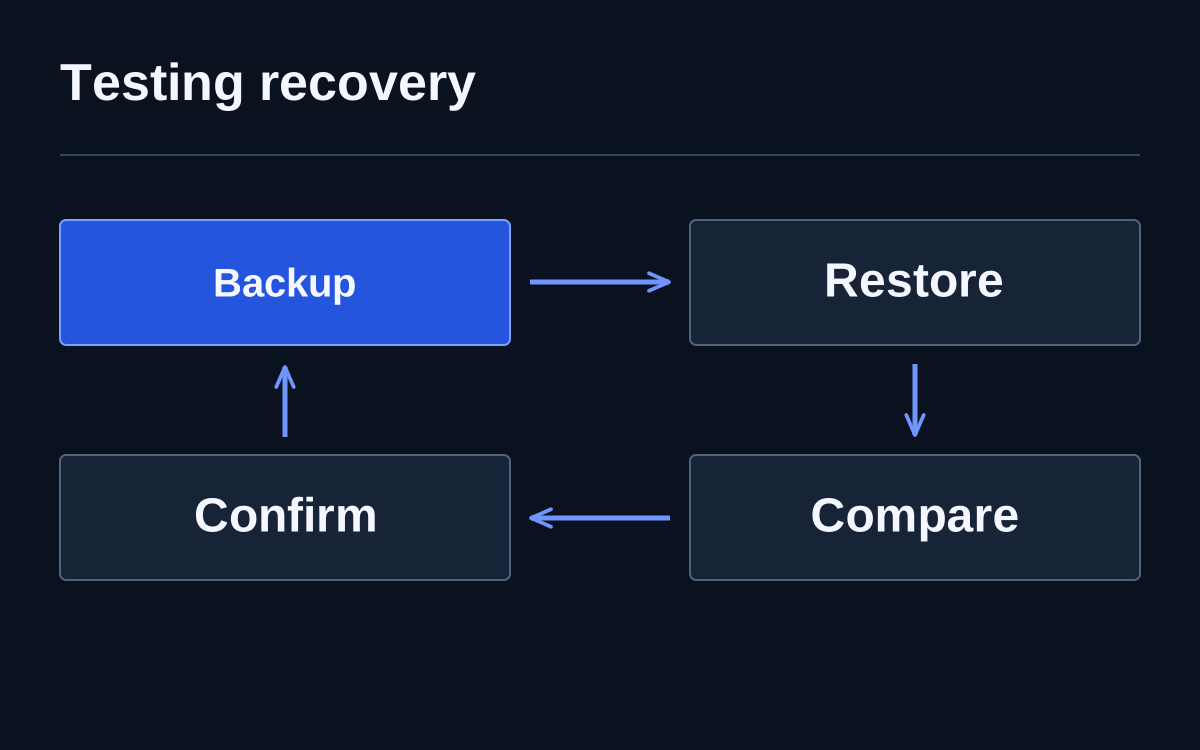
A backup holds data; recovery restores a working service. It may also require settings, a compatible software version, permissions and a startup procedure. A recovery test should end with an ordinary operation, such as creating an order or opening a document.
Imagine a warehouse after a failure
Imagine a fictional warehouse backing up its order database nightly. After a practice shutdown, the team discovers that label printing needs a separate packaging directory excluded from the backup. The database opens, but shipping cannot resume. Calling database startup the end of the test would miss the gap.
Define recovery as a chain: find an order, check stock, prepare shipment and produce a correct label. List the dependencies needed for that chain. An unexpectedly important component may be a document template or access to an external portal rather than the largest server.
Agree two limits
One limit is how many recent changes may be lost. The other is how long the process may remain unavailable. These differ: frequent copying reduces the potential data gap but does not necessarily speed deployment of a large system. Conversely, quickly starting an old copy does not restore missing transactions.
Agree the limits with the process owner. In the example, lost recent orders may require checking email and re-entering them. That reconciliation time is part of the actual return to work. Include manual work after the technical operation in the discussion.
Recover in a separate environment
Before a trial, define an isolated location, permissions and handling rules for copies. A restored service must not accidentally send old customer notifications or repeat external operations. The technical team documents disconnected links and how results will be checked without affecting current work.
Measure from the agreed scenario's start until a reference operation passes. Record waiting for passwords, resources and specialists separately. Timing only file copying produces an attractive number that omits delays most painful during a real outage.
Check independence and copy quality
If the main service and its backups depend on one account, one problem can affect both. The technical team chooses the separation method; the verifiable goal is that failure or corruption of the working environment does not make every copy unavailable. CISA specifically addresses deletion or encryption of backups accessible to an attacker.
During recovery, compare reference records and their relationships. A table that opens may still contain an incomplete period, outdated settings or data from different times. For the warehouse, check consistency between orders and stock rather than simply count recovered files.
Finish with repeatable instructions
After the trial, retain a short procedure with dependencies, contacts, the reference operation and discovered obstacles. Ask another trained employee to follow at least its key steps. This reveals where the document relies on the author's memory or unstated knowledge.